
How to Use a Japanese Air Conditioner: A Comprehensive Guide

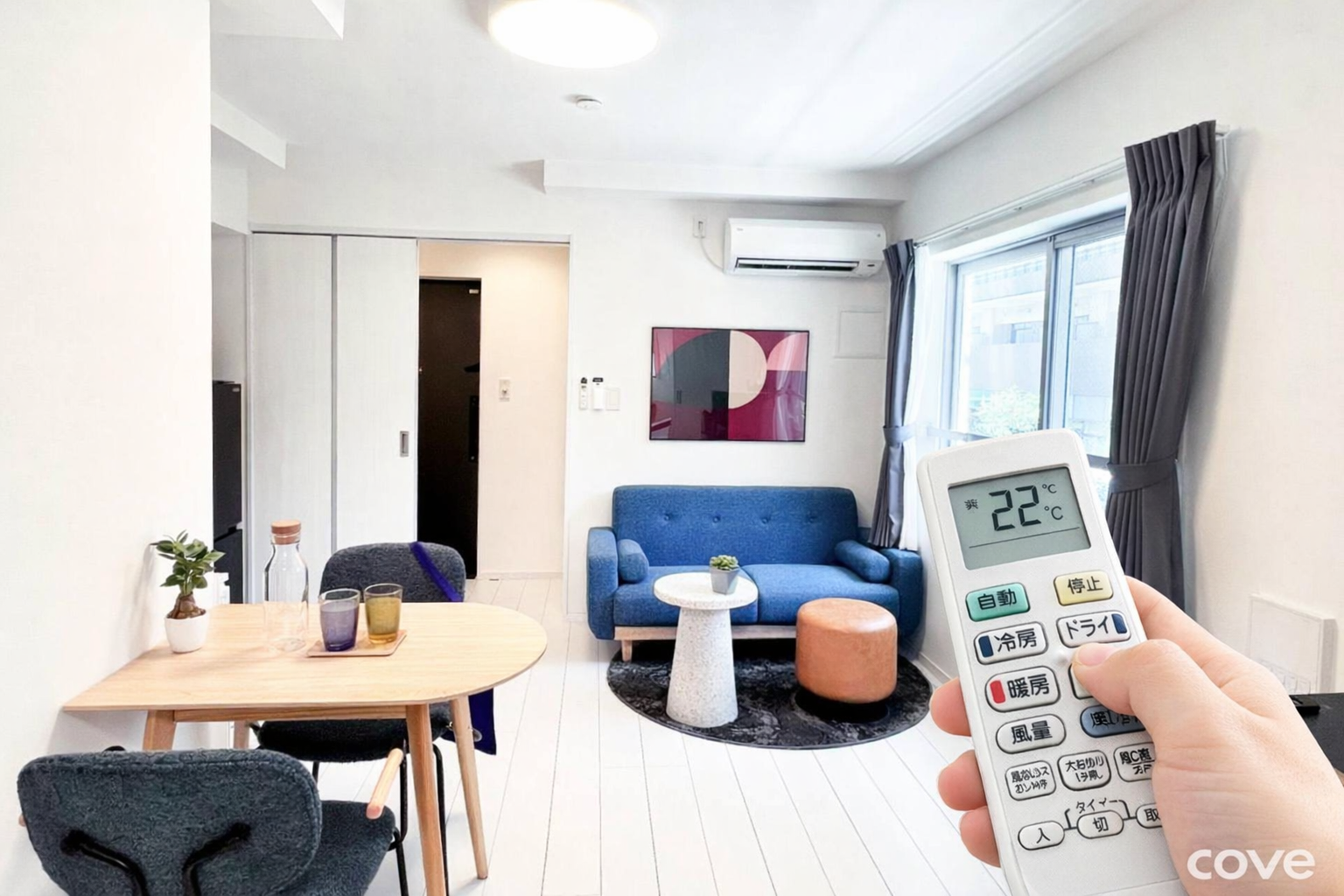
Everything on the remote is in Japanese. You just want the room to stop feeling like a sauna. We get it. This is one of the first things every new tenant asks us about at Cove. The good news: Japanese AC remotes all follow the same basic layout, and once you learn a handful of kanji, you'll have it down in five minutes.
Here's the cheat sheet.
Your Japanese AC Remote: Every Button Translated
The buttons on your remote might be in slightly different positions depending on the brand (Daikin, Panasonic, Mitsubishi, Hitachi), but the kanji stays the same across all of them. Find the characters below on your remote and you're set.
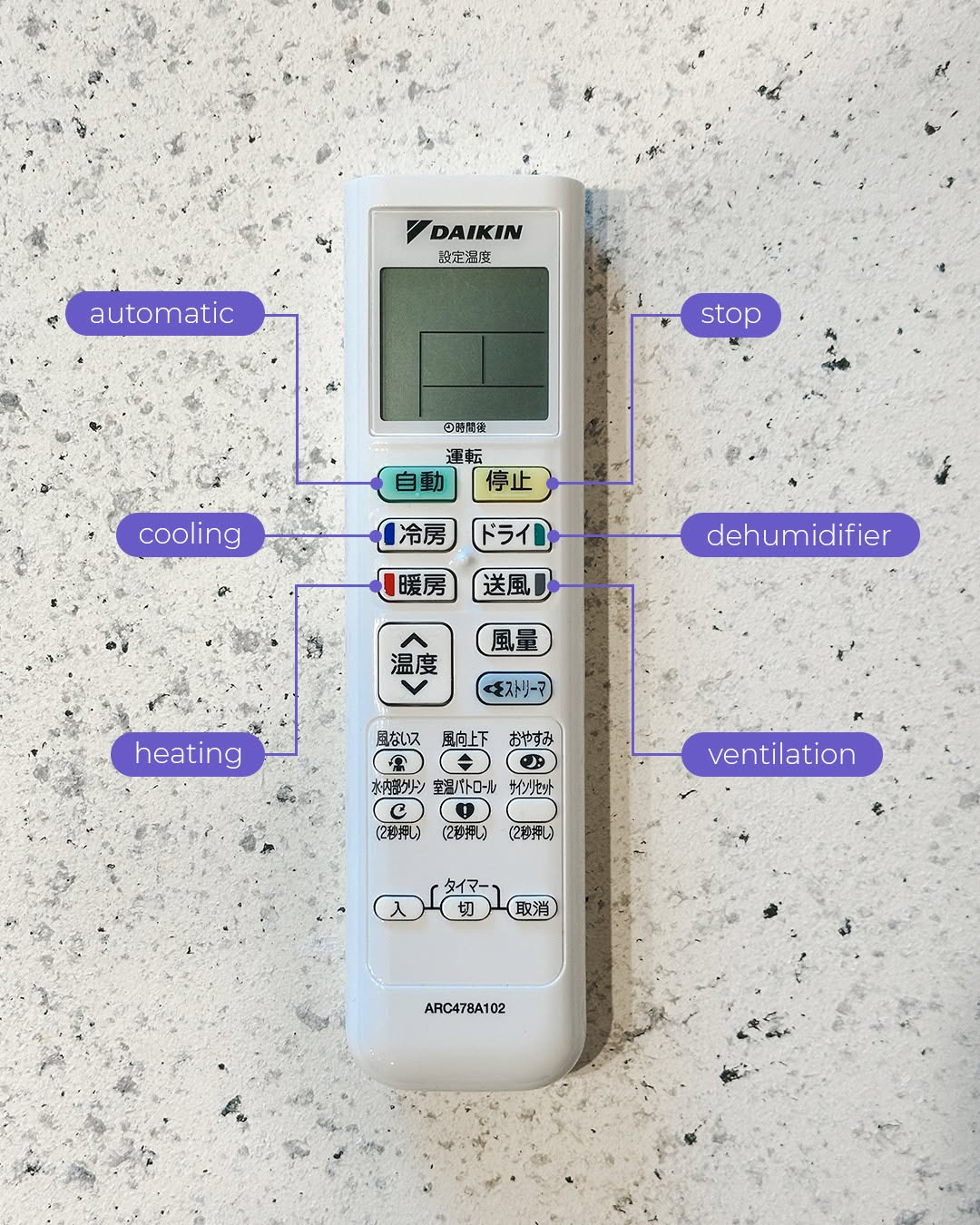
Main controls
| Japanese | Reading | English | What it does |
|---|---|---|---|
| 運転 | unten | On / Start | Turns the unit on |
| 停止 | teishi | Stop / Off | Turns it off |
| 自動 | jidō | Automatic | Adjusts temp and mode by itself. The easiest option |
Modes
| Japanese | Reading | English | When to use |
|---|---|---|---|
| 冷房 | reibō | Cooling | Summer, when it's hot (June–September) |
| 暖房 | danbō | Heating | Winter, when it's cold (December–March) |
| ドライ / 除湿 | dorai / joshitsu | Dry / Dehumidify | Rainy season (June-July). Reduces humidity without overcooling |
| 送風 | sōfū | Fan only | Circulates air on mild days, no heating or cooling |
Adjustments
| Japanese | Reading | English | What it does |
|---|---|---|---|
| 温度 ▲▼ | ondo | Temperature | Raises or lowers the set temperature |
| 風量 | fūryō | Fan speed | Cycles through low, medium, high, and auto |
| 風向 / 風向上下 | fūkō | Airflow direction | Angles the vent flap up or down |
Extra functions
| Japanese | Reading | English | What it does |
|---|---|---|---|
| タイマー | taimā | Timer | Sets the AC to turn on or off at a specific time |
| 入 | iri | Timer on | Activates the timer start |
| 切 | kiri | Timer off | Activates the timer stop |
| おやすみ | oyasumi | Sleep mode | Gradually adjusts temp for comfortable sleep |
| 内部クリーン | naibu kurīn | Self-clean | Dries the inside of the unit to prevent mold. Run after cooling |
| 風量なし | kazanashi | Quiet / No wind | Ultra-low fan speed for minimal noise |
Can't find a button? Look for the kanji above, not the position on the remote. Brands rearrange the layout, but the characters are universal.
Which Mode to Use and When
This is the part most guides skip. Knowing what each button says is one thing. Knowing when to press it is what actually keeps you comfortable year-round.
Summer (June–September): Use 冷房 (cooling) and set it between 26–28°C. During the rainy season in June and July, try ドライ (dehumidify) first. It often makes the room feel cooler without dropping the temperature, and uses less electricity.
Winter (December–March): Switch to 暖房 (heating) at 20–22°C. Your AC will occasionally pause and make a whooshing sound. That's the defrost cycle clearing ice from the outdoor unit. It's normal, and warm air will come back within a few minutes.
Spring and Fall: 自動 (auto) mode handles these transitional months well. The unit reads the room temperature and decides whether to cool, heat, or just circulate air.
Pro tip on airflow direction: In summer, angle the vent upward. Cold air naturally sinks, so pushing it high lets it spread evenly across the room. In winter, point it downward. Warm air rises, so directing it low keeps the heat where you actually feel it.
Save on Your Electricity Bill
Running your AC doesn't have to cost a fortune. A few small habits make a real difference.
Close the doors between rooms. Each wall unit only cools or heats the room it's in. There's no central system distributing air through the apartment. Leaving doors open means your AC is fighting to condition a space twice as large.
Set it at 26°C in summer, not 22°C. Japan's Ministry of the Environment recommends 28°C, but 26°C is a practical sweet spot. Every degree lower than 26°C adds roughly 10% to your electricity cost.
Don't turn it on and off throughout the day. AC units use the most energy during startup. Keeping it at a steady temperature is actually more efficient than cycling it on and off every hour.
Clean the filters. Dirty filters force the unit to work harder, increasing energy use by 15–25%. This one's easy to fix (see below).
For reference, a typical summer electricity bill for a 1-bedroom apartment in Tokyo runs around ¥8,000–15,000 per month. Winter heating is slightly cheaper since the temperature gap between indoor and outdoor is usually smaller.
Filter Cleaning in 5 Minutes
You should do this once a month during summer and winter, when the AC runs daily.
- Open the front panel on your indoor unit. It flips up and clips into place.
- Slide the filters out. There are usually one or two mesh screens.
- Rinse them under running water in the shower or sink. If they're dusty, a soft brush helps.
- Let them dry completely before putting them back. Damp filters encourage mold.
- Snap the panel shut.
That's it. If your AC still smells musty after cleaning the filters, or you can see mold on the fan blades behind the filter, it's time to call in a professional cleaner. A deep clean costs around ¥10,000–15,000 and is worth doing once a year before summer kicks in.
Why Japanese Apartments Don't Have Central AC
If you're coming from the US, Australia, or parts of Southeast Asia, you might be wondering why there's no thermostat on the wall controlling the whole apartment.
Japanese homes use individual wall-mounted units instead of central HVAC systems. Each room gets its own unit with its own remote. This is actually more energy-efficient for the way Japanese apartments are designed. Smaller rooms with sliding doors mean you only condition the space you're using. Close the doors, and let each unit handle its own room.
The one thing that surprises most newcomers: these wall units do both cooling and heating. You don't need a separate heater in winter. Just switch the mode to 暖房 and you're covered.
Living at Cove?
All Cove apartments come fully furnished with all you need. Browse Cove listings →