
2-Bedroom Apartments in Japan (2LDK): a Complete Guide
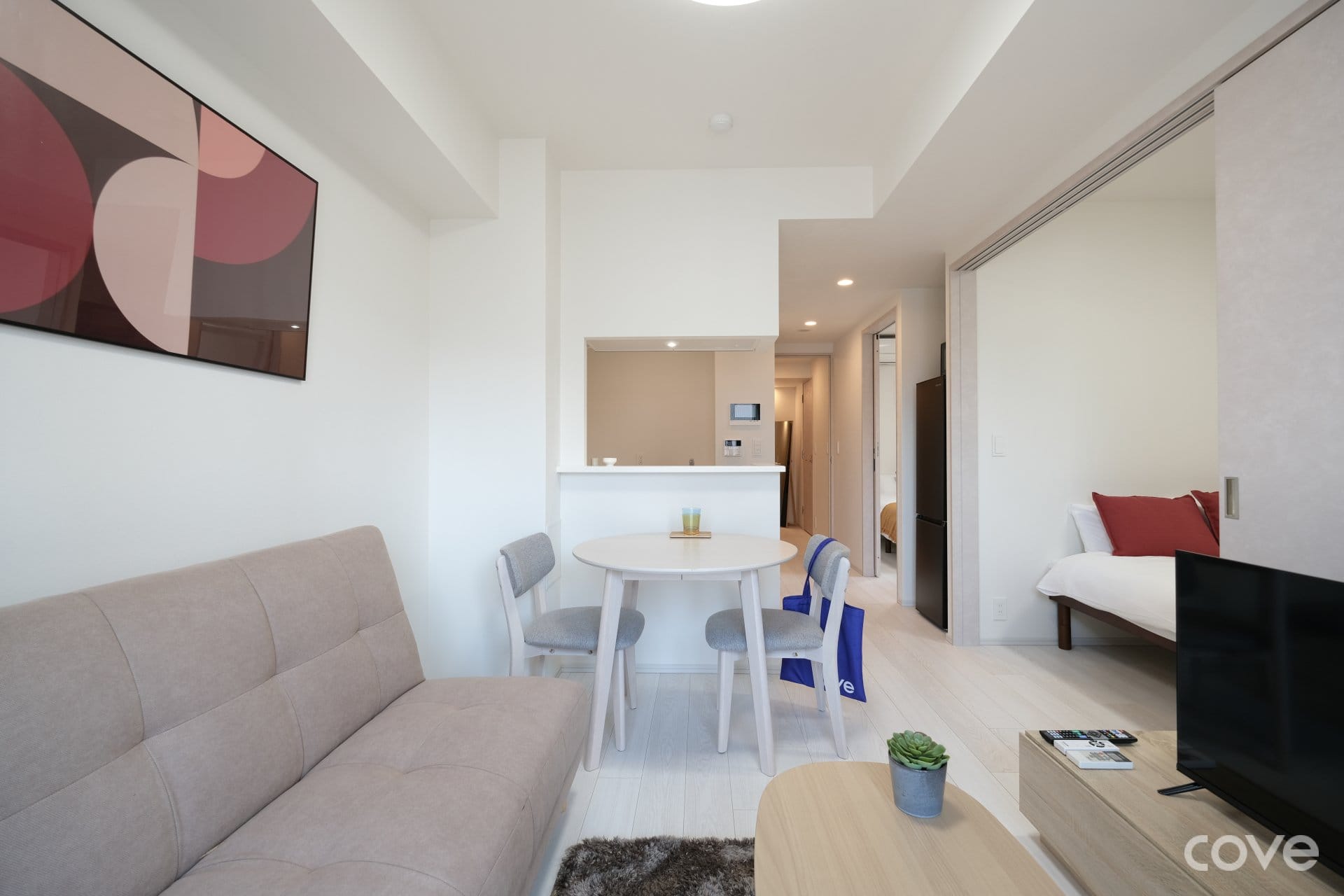
Tokyo 2LDK is for couples planning a family, families with one child, or two-WFH households. 50 to 80 sqm at ¥150,000 to ¥700,000/month.

TL;DR
- A 2LDK is a Japanese apartment layout with two separate bedrooms plus a combined Living, Dining, and Kitchen area, typically 50 to 80 square metres.
- Tokyo 2LDK rent ranges from ¥150,000/month in suburban wards up to ¥700,000/month in central premium areas like Minato or Shibuya.
- 2LDK is the standard layout for couples planning a family, families with one child, two-person remote-working households, and serious roommates.
- Initial costs scale with rent: expect 4 to 6 months rent in upfront fees (¥600,000 to over ¥4 million for premium units).
- Furnished 2LDKs (like Cove's apartments for rent in Tokyo) skip the key money, guarantor company, and ¥1M+ cash outlay, built for couples and families relocating from abroad.
1. What Is a 2LDK Apartment?
2LDK is the layout most foreigners consider when their lifestyle outgrows a 1LDK. Couples adding a partner who works from home full-time, families with one child, two professionals sharing space, expats settling in for the long term, this is the Tokyo apartment that absorbs all of those transitions.
The breakdown: 2 separate bedrooms plus a combined Living, Dining, and Kitchen area. The two bedrooms can be used as bedroom + office, two bedrooms, or bedroom + nursery, most expat households choose one of these three configurations.
If you want the technical side of every Japanese apartment code, our complete guide to Japanese apartment layouts covers 1R through 3LDK and beyond. This article focuses on the practical side: who 2LDK is built for, what it costs, and what to look out for.
One important caveat that surprises foreigners: Japanese real estate agents will sometimes refuse a 2LDK to a single applicant. The assumption is that the second room indicates undisclosed cohabitation, a roommate or unmarried partner. If you're applying solo for a 2LDK, bring documentation (employment letter, written explanation of intended use of the second room) to the application stage.
2LDK vs nearest neighbours
Feature | 1LDK | 2LDK | 3LDK |
Rooms | 1 + LDK | 2 + LDK | 3 + LDK |
Total size | 30–50 sqm | 50–80 sqm | 70–100+ sqm |
Best for | Couples, solo upgrade | Couples WFH, family + 1 kid | Family + 2 kids |
Tokyo avg rent | ~¥113K | ¥150–350K outer; ¥300–700K central | ¥250K+ |
2. How Big Is a 2LDK Really?
2LDK in Tokyo can mean 50 sqm or 100 sqm. That's a 2x range, and most listings hover at the lower end. Setting expectations matters here.
A typical 60 sqm Tokyo 2LDK breaks down roughly like this: bedroom 1 around 10 sqm, bedroom 2 around 7 sqm, LDK around 20 sqm, with the remaining space absorbed by the bathroom and genkan. The second bedroom is rarely a true second master, it's the room you use as office, nursery, or spare bedroom.
LDK shape varies between newer and older builds. Newer 2LDKs tend to have rectangular open-plan LDKs that allow flexible furniture arrangements. Older 2LDKs may have two adjacent rooms separated by a removable fusuma (sliding paper door), technically two rooms when closed, one large room when open. More flexibility, but worse sound insulation.
From r/japanlife threads: a 60 sqm 2LDK feels "comfortable for two adults, tight for a family of four." Most Tokyo families upgrade to a true 3LDK around the time they have a second child or the first child needs their own room, typically by year five.
3. Who Should Rent a 2LDK in Tokyo?
This is the layout where lifestyle decisions and apartment decisions become inseparable. The second room is what you make of it.
The clear yeses
- Couples both working from home. 2LDK lets each partner take calls in a separate room. This is the single most-quoted reason couples upgrade from 1LDK in r/japanlife threads.
- Couple + 1 child (under school age). One master bedroom, one nursery, shared LDK. Standard layout for young Tokyo families.
- Family of 3 or 4 (kids under 10). Tight but workable, especially if parents share one bedroom and kids share the second. Plan to upgrade to 3LDK as kids reach age 8–10.
- Long-stay couples (3+ years in Tokyo). The office room compounds in value over time. After year two of a multi-year stay, the daily quality-of-life delta from a 1LDK justifies the higher rent.
- Couple + frequent overnight guests. A second room as guest room solves the most awkward part of 1LDK life, hosting friends and family on a sofa bed in your living room.
The maybes
- Two roommates. Works if you genuinely like each other and can handle a shared LDK. Reddit threads note Japanese landlords often interpret two unrelated names on a lease unfavourably.
- Single + serious hobby (music studio, art). The second room can be a studio. Be prepared to justify the application to the landlord with a written explanation.
The clear nos
- Solo without justification. Most landlords will refuse. Either go 1LDK or be ready to bring documentation explaining the second-room use.
- Family of 5+. You've outgrown 2LDK. Look at 3LDK or a detached house outside the 23 wards.
4. The Real-World Pros and Cons
This is the layout where the foreigner application process gets harder, not just the rent. Pulled from r/japanlife threads where foreigners shared real experiences.
The wins
- Two private spaces, game-changing for any household with two people who occasionally need separation.
- Future-proof. Absorbs a kid, a guest, a hobby, or a WFH spouse without forcing a move.
- Hosting capability. The guest room means out-of-town friends and family can visit comfortably.
- Resale-friendly long term. If you eventually buy, 2LDK is the most-traded family layout in Tokyo's secondary market.
- Better building stock. Most 2LDK units sit in newer, RC (concrete) buildings with better soundproofing and earthquake ratings.
The trade-offs
- Application discrimination harder. Reddit threads document foreigners being refused 2LDK applications even with strong income. Mitigation: use a foreigner-friendly platform; bring extra documentation (employment letter, marriage or birth certificates).
- Initial fees scale brutally. ¥250,000/month rent means ¥1 to ¥1.5 million in cash on day one. Mitigation: furnished options bypass key money and guarantor entirely.
- Bedroom 2 is small. Listings round up; the second bedroom is often closer to a 5 sqm closet than a bedroom. Mitigation: insist on floor plan dimensions before viewing.
- Single occupants get refused. Landlords assume undisclosed roommates. Mitigation: prepare a written explanation of intended use of the second room (office, hobby, guest).
- Older 2LDKs use fusuma not walls. The "two rooms" may be one large room divided by a sliding paper door, minimal sound insulation. Mitigation: filter for post-2000 RC builds.
5. How Much Does a 2LDK Cost in Tokyo?
2LDK is where rent becomes a serious financial commitment. The spread is enormous, ¥150,000 to ¥700,000 per month, so the tier you target matters more than the exact unit you pick within that tier.
Monthly rent ranges by ward (2026)
Tier | Example wards | 2LDK monthly | Notes |
Premium | Minato, Chiyoda, Shibuya | ¥350,000 – ¥700,000+ | Top of luxury market |
Central | Meguro, Shinjuku, Bunkyo | ¥250,000 – ¥400,000 | Common expat family range |
Suburban | Setagaya, Koto, Sumida | ¥180,000 – ¥280,000 | Quieter, family-oriented |
Outer | Adachi, Katsushika, Edogawa | ¥150,000 – ¥220,000 | Best value; longer commute |
If you're looking at the premium tier specifically, see Cove's luxury apartments in Tokyo for properties matching this range.
The total move-in cost reality
For 2LDK, initial costs become a serious cash event. Walk through the math so you can budget honestly:
- Shikikin (deposit): 1–2 months rent. ¥250K rent means ¥250K to ¥500K, partially refundable.
- Reikin (key money): 1–2 months. ¥250K to ¥500K, NOT refundable.
- Agency fee: 0.5–1 month plus tax. ¥125K to ¥275K.
- Guarantor company: 0.5–1 month, mandatory without a Japanese guarantor. ¥125K to ¥250K.
- First month rent + utility setup: ¥260K to ¥280K.
All in: a ¥250,000/month 2LDK can hit ¥1 to ¥1.5 million on day one. For premium ¥500,000+ units, initial costs cross ¥3 million routinely. This is the cash event that catches families relocating to Tokyo most off-guard.
The furnished alternative
For couples and families relocating internationally, Cove's furnished apartments in Tokyo include all furniture, utilities, Wi-Fi, and (for select properties) housekeeping in one monthly figure. No key money. No Japanese guarantor required. No application gauntlet, designed specifically for foreigners moving to Tokyo.
Best fit: families on 1 to 24 month assignments, couples upgrading from a 1LDK, or anyone who values being moved in this week over saving on monthly rent. Cove sits in the premium end of Tokyo's furnished market because the build quality and location quality match, the equation is paying slightly more per month to skip the ¥1M+ cash outlay and the multi-week furniture-shopping marathon.
6. Best Tokyo Neighbourhoods for 2LDK Renters
Couples and families pick neighbourhoods around quality of life: quiet streets, parks, schools, weekend cafes. Each entry below kept brief; the underlying truth is that 2LDK renters tend to choose neighbourhood first, apartment second.
- Setagaya (Sangenjaya, Yoga, Komazawa). Tokyo's largest residential ward. Leafy, kid-friendly parks, expat-popular. The standard family choice.
- Meguro and Nakameguro. Central premium with family amenities. Strong choice for couples planning kids who want central walkability.
- Bunkyo. Quiet, university-adjacent, top-rated public schools. Tokyo families who can afford it gravitate here.
- Koto (Kiyosumi-Shirakawa, Toyosu). Newer 2LDK stock in waterfront and emerging arts areas. Often better value than west Tokyo. Browse Kiyosumi apartments for rent if this area appeals.
- Shibuya and Ebisu. Premium central. For couples both working in central Tokyo who want walkable lifestyle and don't mind paying for it.
- Asakusa. Old-Tokyo character with growing café and gallery scene. 2LDK stock here often runs better-value than west-side wards. See furnished apartments in Asakusa.
- Kichijoji and Mitaka. Outside the 23 wards but consistently rated Tokyo's most-livable. Great for families who don't need daily central commute.
7. How to Find Your 2LDK in Tokyo
Six steps from research to viewing:
- Set your real budget: monthly rent plus a ¥1 to ¥1.5 million initial-fees buffer. Or skip both with a furnished option.
- Decide bedroom 2 use: office, nursery, guest room, hobby. This drives whether you need full sound insulation between rooms.
- Pick two to three neighbourhoods. Weight schools (if kids), commute, and weekend walkability.
- Filter for building age and construction: post-2000, RC, hinged interior doors (not fusuma).
- Prepare your application package: employment letter, income proof, marriage or birth certificates if relevant. 2LDK applications get scrutinised more than 1LDK.
- Use a foreigner-friendly platform. Japanese-language sites are a barrier, and many landlords decline foreign applicants at agent stage.
If you'd rather skip the six-week paperwork process entirely, browse Cove's apartments for rent in Tokyo. Foreigner-friendly, fully furnished, no key money, no guarantor required.
8. Frequently Asked Questions
What does 2LDK mean?
2LDK = 2 separate rooms plus a combined Living, Dining, and Kitchen area. The two rooms are usually used as bedrooms, an office, or one of each. Total size ranges 50 to 80 sqm in most Tokyo listings.
How big is a 2LDK in Tokyo?
Typically 50 to 80 sqm, with an average around 60 sqm. Luxury 2LDKs can exceed 100 sqm. The second bedroom is often noticeably smaller, closer to 6 sqm than 10 sqm.
Can a single person rent a 2LDK in Tokyo?
Legally yes, but Japanese agents and landlords often refuse single applicants for 2LDK because they suspect undisclosed cohabitation. Bring documentation explaining your intended use of the second room (office, hobby, etc.).
How much does a 2LDK cost to rent in Tokyo?
¥150,000 to ¥700,000+ per month depending on ward and quality. Suburban wards (Adachi, Katsushika) start around ¥150K; central premium (Minato, Shibuya) tops out above ¥700K.
Is a 2LDK good for a family with a baby?
Yes, 2LDK is the standard layout for Tokyo families with one young child. One bedroom for parents, one as nursery, shared LDK. Most families upgrade to 3LDK around the time the child turns 5 to 7.